Top Stories
When Double Counting Doubled the Headlines
Early last week, it was revealed that Polymarket volumes shown on most public dashboards were overstated due to a double-counting error, where both sides of each trade were counted, inflating reported totals. After correcting to the industry-standard single-side measurement, historical prediction market volumes are meaningfully lower. For example, November 2025 combined Polymarket and Kalshi volume now stands at $7.68B versus over $9B previously, with prediction markets at 0.47% of spot volumes. While the fix reshapes reported market share, the core story remains intact: prediction markets continue to scale, deepen liquidity, and grow on a more accurate baseline.
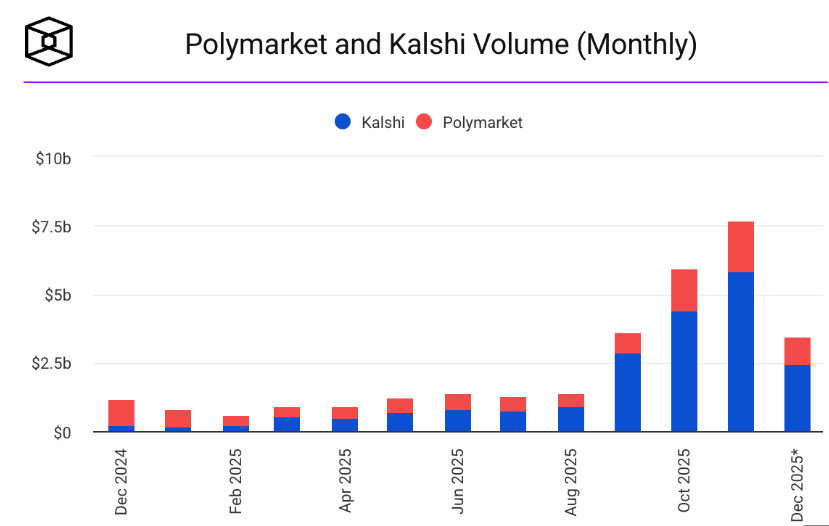
Source: The Block, Kalshi
Coinbase’s Everything Bagel
Coinbase is rolling out stocks, prediction markets, Solana DEX trading, derivatives, custom stablecoins, and payments as it pushes to become an “everything exchange” that blends centralized and onchain activity in a single app. The expansion includes commission-free stock and ETF trading in the U.S., integrations with Kalshi and Jupiter, broader retail access to futures, and a growing focus on stablecoins as both a payments and infrastructure layer. Together with new AI tools, business banking, and deeper Base integration, the strategy reflects Coinbase’s ambition to own the full financial stack rather than just crypto trading.
Burn, Baby, Burned Already
Hyperliquid’s proposed burn of its Assistance Fund has stirred debate but appears largely symbolic, as markets had already priced the fund as effectively burned supply. Despite a brief HYPE bounce following the announcement, price action quickly reverted, reinforcing the view that the move is a nonevent rather than a true catalyst. At the same time, sentiment pressure is rising as competitors like Lighter attract attention with aggressive incentives, even as Hyperliquid’s infrastructure remains the most battle-tested amid recent market stress.
Tokenization’s Fork in the Road
This week’s wave of tokenization announcements shows crypto rails are becoming mandatory for finance, but they also expose a growing divide between isolated and composable onchain systems. Synthetic shortcuts like equity-linked perps highlight the risks of forcing TradFi assets into DeFi without structural alignment, while permissioned pilots such as DTCC’s tokenized Treasuries favor safety by recreating closed financial silos onchain. In contrast, efforts like Superstate bringing real tokenized securities into open DeFi point toward a more durable model, where compliant assets plug into transparent, always-on financial systems. The real promise of tokenization lies not in issuing assets on blockchains, but in integrating them into open markets where liquidity, risk, and settlement interact seamlessly.
Memecoins at Scale
Memecoins in 2025 became a large-scale experiment in crypto issuance and attention, with activity exploding first on Solana before spreading across Base and BNB Chain as launchpads competed on distribution, incentives, and integrations rather than token design. Issuance peaked above 40,000 tokens per day as memecoins drove transactions, liquidity, and fees, but momentum faded as retail fatigue set in and volumes and market caps fell. The cycle ultimately highlighted both crypto’s ability to rapidly bootstrap liquidity and users at scale, and the inherently cyclical nature of memecoins, which thrive on novelty and distribution but struggle to sustain demand over time.
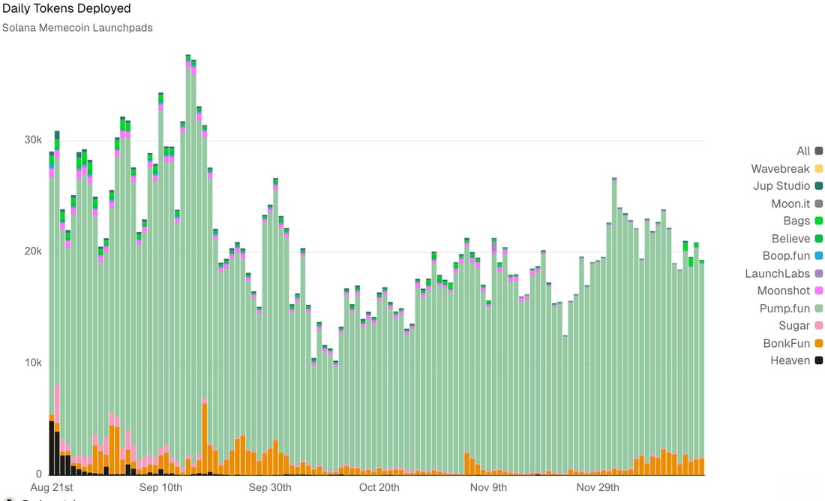
Source: Dune
Regulation
All That Glitters Goes Onchain
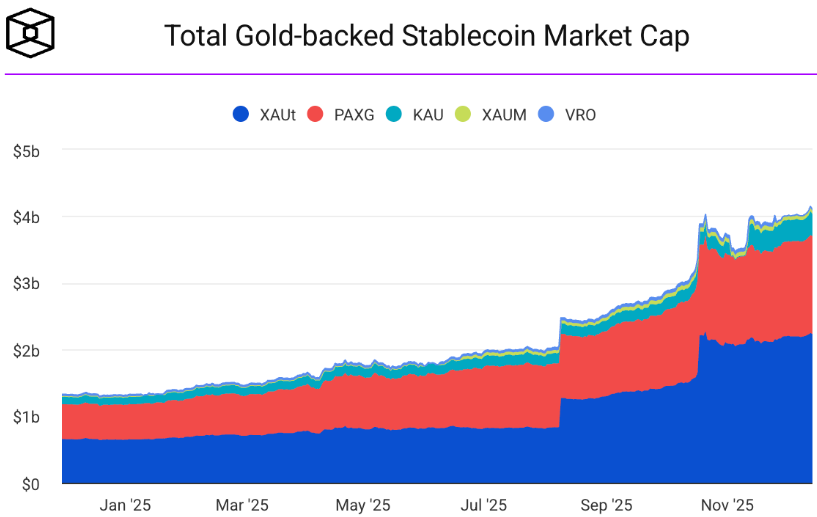
Gold-backed stablecoins have grown to over $4 billion in market capitalization in 2025, nearly tripling from about $1.3 billion at the start of the year, driven by gold’s roughly 66% year-to-date price rally and rising crypto demand for tokenized safe-haven assets. Tether Gold and Paxos Gold dominate the space with nearly 90% combined market share, led by XAUt after aggressive supply expansion. The trend highlights a growing preference among crypto investors for onchain exposure to physical gold, a shift underscored by Tether’s rapid accumulation of gold reserves, now placing it among the world’s top 30 holders globally.
Source: Coingecko, The Block
Money Markets, Meet MetaMask
JPMorgan is launching its first tokenized money-market fund on Ethereum, seeding the vehicle with $100 million of its own capital ahead of opening it to outside investors this week. The fund, MONY, targets qualified investors and uses JPMorgan’s Kinexys platform to issue onchain tokens, with subscriptions and redemptions available in cash or USDC and yield accruing daily like a traditional money-market fund. The move underscores accelerating institutional demand for tokenization and places JPMorgan alongside firms like BlackRock and Goldman Sachs in the race to bring yield-bearing assets onchain.
Stablecoins as Statecraft
Stablecoins are increasingly becoming a matter of national economic interest, as their durable growth gives governments a new lever to extend currency influence online. The U.S. is moving to treat dollar stablecoins as strategic infrastructure by regulating issuers as key choke points, steering reserves into Treasuries, and promoting public blockchains as global settlement rails to expand USD reach. For Europe, the challenge is whether it can mirror this approach and enable euro stablecoins to scale quickly enough to compete with already entrenched dollar-based alternatives.

Source: Token Terminal
Washington Gets Serious About Crypto Scams
U.S. senators Elissa Slotkin and Jerry Moran introduced the bipartisan SAFE Crypto Act, which would create a federal task force bringing together Treasury, law enforcement, regulators, and private-sector experts to better coordinate the fight against crypto-related fraud. The task force would track emerging scam trends, support local police with investigative and education tools, and report findings to Congress on a recurring basis. The proposal aims to close enforcement gaps around hacks, phishing, and smaller-scale fraud as illicit crypto activity is estimated to exceed $50 billion annually.
Other Domestic Regulation Updates
- Visa launches 'stablecoins advisory practice' to help banks and businesses build strategies
- Trump to interview pro-crypto Christopher Waller for next Fed Chair
- SEC says broker-dealers need to maintain crypto private keys to comply with customer protection rules
- US crypto czar David Sacks says Clarity Act markup confirmed for January
- Digital Asset Treasuries Draw In $2.6B Amid Crypto Market Uncertainty
- DTCC Taps Canton Network to Test Tokenized Treasuries
Other International Regulation Updates
- Japan's SBI Holdings to launch yen-pegged stablecoin with Startale
- Terraform Labs liquidator sues Jump Trading for $4 billion in damages
- Strategy Adds Nearly a Billion Dollars in Bitcoin for Second Straight Week
- Brazil’s Largest Asset Manager Recommends Investors Put Up to 3% of their Money in Bitcoin to Hedge Against FX, Market Shocks
Pain & Gain
Pain
- Where Are The Bitcoin Users?
- Bitcoin, Ethereum ETFs Shed $582M in a Day as Institutions Trim Risk
- Singapore Entrepreneur Loses Entire Crypto Portfolio After Downloading Fake Game
Gain
- Ripple taps Wormhole to expand RLUSD to Layer 2 chains like Base and Optimism
- Bitwise CIO says bitcoin will break 4-year cycle and set new all-time highs in 2026
- Cathie Wood's Ark Invest buys the dip on BitMine, Coinbase and Circle shares
- 2026 Digital Assets Outlook Report
- Visa Launches USDC Settlement in the US
Important Legal Notices
This reflects the views MJL Capital LLC (“MJL”), but it should in no way be construed to represent financial or investment advice. Nothing in this correspondence is intended to constitute or form part of, and should not be construed as, an issue for sale or subscription of, or solicitation of any offer or invitation to subscribe for, underwrite, or otherwise acquire or dispose of any security, including any interest in any private investment fund managed by MJL. Any such offer may only be made pursuant to a formal confidential private placement memorandum of any such fund, which may be furnished to potential investors upon request and which will contain important information to be considered in connection with any such investment, including risk factors associated with making any investment in any such fund. Further, nothing in this correspondence is, or is intended to be treated as, investment or tax advice. Each recipient should consult their own legal, tax and other professional advisors in connection with investment decisions.

Domenic Salvo is a Managing Partner at MJL Capital, helping lead Portfolio Research and Investor Relations.