Top Stories
Prediction Markets, Now With Gamma
Polymarket’s move toward fees following its Dow Jones and WSJ partnership marks a shift from pure growth to product expansion, with its new structure looking less like an anti-bot measure and more like a bid to capture crypto’s leverage-hungry traders. While the U.S. app introduces simple taker fees as its first formal revenue stream since 2020, the legacy app’s maker rebate model on 15-minute crypto markets aims to deepen liquidity and improve execution rather than suppress bots, which already enhance market efficiency. Coupled with UI upgrades and tighter live markets, Polymarket is effectively repackaging micro-dated options on crypto price moves, positioning itself to compete directly with perps and DeFi options as it enters its mainstream era in 2026.
Uniswap Flips the Switch
Uniswap’s activation of its fee switch in late December marked a structural shift for UNI, redirecting protocol and sequencer fees into buybacks and burns and immediately retiring roughly 100M UNI, effectively reclaiming years of uncaptured value. With ongoing burns now tied to recurring fee generation, UNI moves from a pure governance token toward a fee-backed, deflationary asset. The change raises the bar for DEX token economics and intensifies competition, as rivals already offer more direct fee distribution, signaling that credible monetization is now a baseline requirement rather than an optional upgrade.
Source: Dune
Jupiter Goes Native on Stablecoins
Jupiter’s launch of JupUSD on January 5, backed primarily by BlackRock-linked USDtb and deeply integrated across its entire Solana superapp, is less about adding another stablecoin and more about locking in strategic control. By owning a native stablecoin, Jupiter can internalize reserve yield, unify liquidity across swaps, perps, lending, and predictions, and reduce dependence on third-party issuers, as shown by rapid early deposits and adoption. In an ecosystem with roughly $15B in stablecoin supply, JupUSD underscores how stablecoins are evolving from interchangeable assets into core infrastructure, where distribution and integration, not branding alone, define competitive advantage.
Why Zcash’s Selloff Missed the Point
ZEC’s selloff following the Electric Coin Company leadership resignations reflects a misreading of what actually broke, which was not Zcash’s developer base but its governance model. The core team remains intact and continues building, but the episode exposed the limits of nonprofit oversight when it comes to shipping competitive, consumer-facing products like wallets. Rather than signaling protocol decay, the split highlights a broader industry lesson: decentralized networks still need empowered companies to build, iterate, and raise capital, and when governance structures prevent that, markets confuse structural realignment with failure.
Miners Survive the Halving, Then Pivot
In 2025, Bitcoin miner revenue rose modestly to an estimated $17.2B, but fee income collapsed as last year’s Ordinals-driven activity faded, pushing miners back toward near-total reliance on block subsidies even as hash rate hit a record 1 zetahash. Despite this pressure, publicly traded miners sharply outperformed Bitcoin itself, driven not by block rewards but by a strategic pivot into AI infrastructure that monetized existing power and data-center assets. The result was a growing divergence between Bitcoin’s network economics and miner equity performance, highlighting how mining firms are increasingly valued as diversified infrastructure plays rather than pure BTC proxies.
Regulation
Don’t Forget Where Venezuela’s Bitcoin Came From
Speculation about a massive Venezuelan Bitcoin seizure misses the darker reality behind those claims. Any crypto tied to the Maduro regime likely stems from sanctions evasion, corruption, and outright theft, including the use of stablecoins to bypass blocked financial rails and the systemic confiscation of mining equipment from ordinary citizens. Onchain data verifies only a small, publicly visible Bitcoin balance, with the oft-cited $60 billion figure resting on unproven estimates rather than hard evidence. Whatever assets may ultimately be seized, they were not created through innovation or foresight, but through repression, coercion, and the extraction of wealth from a population already pushed to the brink.
Wall Street Doubles Down on Spot Crypto
Morgan Stanley filed S-1 registrations to launch spot Bitcoin and Solana ETFs, including a staking-enabled Solana fund, signaling a deeper commitment to regulated crypto exposure. The move places the bank alongside incumbents like BlackRock and Fidelity as U.S. spot crypto ETF volumes surpass $2 trillion and Bitcoin ETFs alone hold over $123 billion in assets. Enabled by a more favorable SEC backdrop and faster ETF listing standards, the filings build on Morgan Stanley’s broader strategy to expand crypto access across client portfolios and retirement accounts.
Ripple Stays Private, Builds the Stack
Ripple reiterated that it has no plans to go public, arguing that its balance sheet and liquidity allow it to fund growth without the pressures of public markets. After raising $500 million at a reported $40 billion valuation and completing nearly $4 billion in acquisitions in 2025, the company is positioning itself as a full-stack enterprise digital asset provider. With Ripple Payments processing over $95 billion in volume and RLUSD anchoring its institutional offerings, Ripple is choosing private scale over an IPO spotlight.
Crypto Rings the Bell, Then Meets Reality
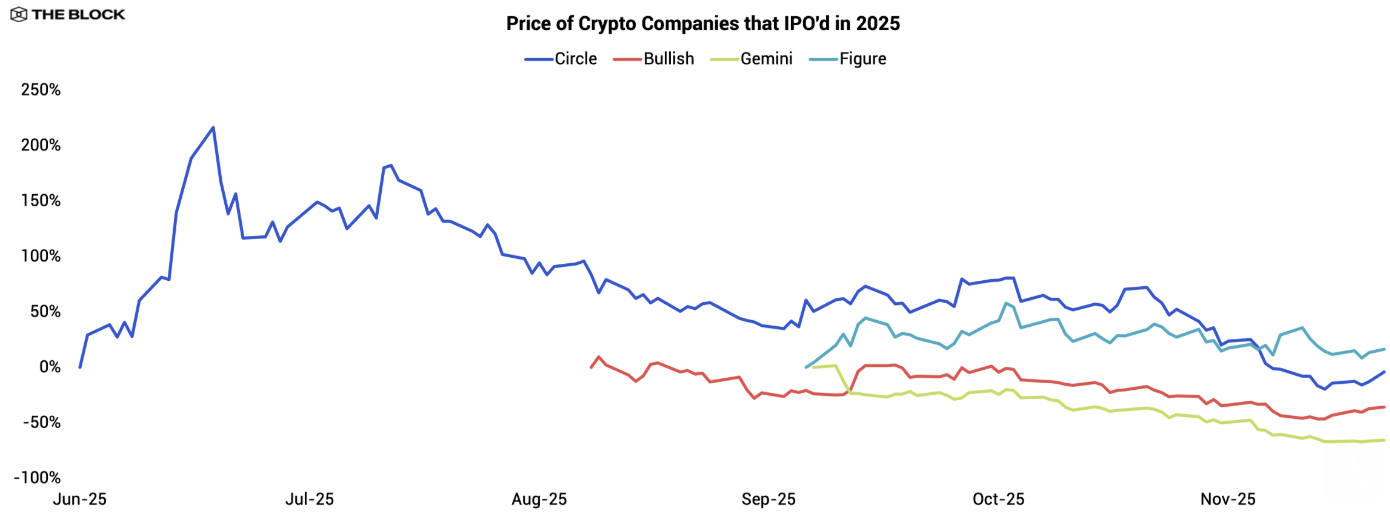
After years of regulatory overhang, 2025 marked crypto’s return to public markets as a wave of IPOs signaled renewed equity investor appetite for digital asset exposure. Circle’s blockbuster NYSE debut, which raised roughly $1.1 billion and saw shares surge nearly 290% on day one, became the defining moment, even as the stock later retraced sharply, highlighting the gap between IPO excitement and durable public market support. Regulatory easing under the Trump administration, including dropped SEC enforcement actions and clearer frameworks like Project Crypto, helped unlock these listings, but volatile post-IPO performance across the sector underscored that while public markets are once again open to crypto, they remain unforgiving of risk, valuation excess, and unproven business models.
Source: The Block
Other Domestic Regulation Updates
- Polymarket and Parcl Launch Real Estate Prediction Markets
- Community banks sound alarm on yield-bearing stablecoin loophole in GENIUS
- PwC to deepen crypto-related work
- Cathie Wood says US government may soon start buying bitcoin for strategic reserve
Other International Regulation Updates
- Ripple’s President Rules Out IPO Plans Following $500M Raise
- Switzerland freezes assets linked to Venezuela’s Maduro after US arrest
- Kalshi CEO endorses bill banning insider trading on prediction markets
- Ripple secures FCA authorization, clearing path for UK expansion
- Colombia's tax authority mandates crypto exchanges to submit user data
Pain & Gain
Pain
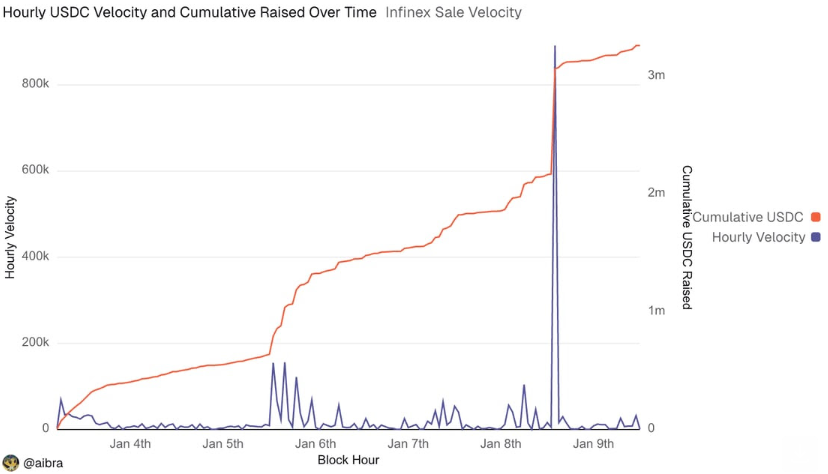
- Infinex Changes ICO Terms Following Low Demand
- Zcash (ZEC) dropped nearly 20% across the 24 hours following the announcement of the mass resignation on Wednesday, January 7, 2026
- BNB dropped 2.6% to $883 over the last 24 hours, failing to sustain the $900 resistance level amid broader crypto market pullbac
- Bitcoin has dropped below $90,000, currently trading at $89,881, causing leveraged long positions worth over $477 million to be liquidated in the past 24 hours
- Zcash developers quit, form new company after board clash
- Truebit Hack Wipes Out TRU in First Major Exploit of 2026
Gain
- Crypto Exploit Losses Fell 60% in December Despite Ongoing Hacks
- Render Soars 30% as AI-Focused Tokens Rally
- How Digital Asset Treasuries Went Mainstream in 2025
- Uniswap Fee Switch Early Results
- Grayscale begins distributing staking rewards to Ethereum ETF investors
Important Legal Notices
This reflects the views MJL Capital LLC (“MJL”), but it should in no way be construed to represent financial or investment advice. Nothing in this correspondence is intended to constitute or form part of, and should not be construed as, an issue for sale or subscription of, or solicitation of any offer or invitation to subscribe for, underwrite, or otherwise acquire or dispose of any security, including any interest in any private investment fund managed by MJL. Any such offer may only be made pursuant to a formal confidential private placement memorandum of any such fund, which may be furnished to potential investors upon request and which will contain important information to be considered in connection with any such investment, including risk factors associated with making any investment in any such fund. Further, nothing in this correspondence is, or is intended to be treated as, investment or tax advice. Each recipient should consult their own legal, tax and other professional advisors in connection with investment decisions.

Domenic Salvo is a Managing Partner at MJL Capital, helping lead Portfolio Research and Investor Relations.