
Top Stories
Volatility Stress-Tests Onchain Infrastructure
This week’s selloff delivered crypto’s sharpest volatility shock since 2022, with Bitcoin briefly breaking below $60,000, nearly $7 billion in total liquidations, and roughly $2 trillion erased from market cap as risk-off sentiment swept across asset classes. Yet onchain infrastructure absorbed the stress at scale: lending protocols like Morpho and Aave processed heavy liquidations with minimal bad debt, while perp DEXs led by Hyperliquid posted record volumes amid the turbulence. The episode underscores a structural shift in market plumbing, where leverage unwinds and risk transfer increasingly occur on transparent, programmatic rails, making real-time visibility and automated execution central to modern crypto market resilience.

Source: Dune
When 2,000 Won Becomes 2,000 BTC
South Korean exchange Bithumb accidentally credited 695 users with 2,000 BTC each instead of a small cash reward, briefly assigning tens of billions of dollars’ worth of phantom Bitcoin on its internal ledger. Though the error was corrected within five minutes and involved no onchain transfers, some users managed to sell portions of the mistakenly credited balances, triggering a sharp, exchange-specific flash crash that sent BTC prices on Bithumb as low as $55,000. The incident highlights how internal accounting errors, even without blockchain movement or security breaches, can rapidly distort market prices and liquidity on centralized platforms.
Prediction Markets Hit Institutional Depth
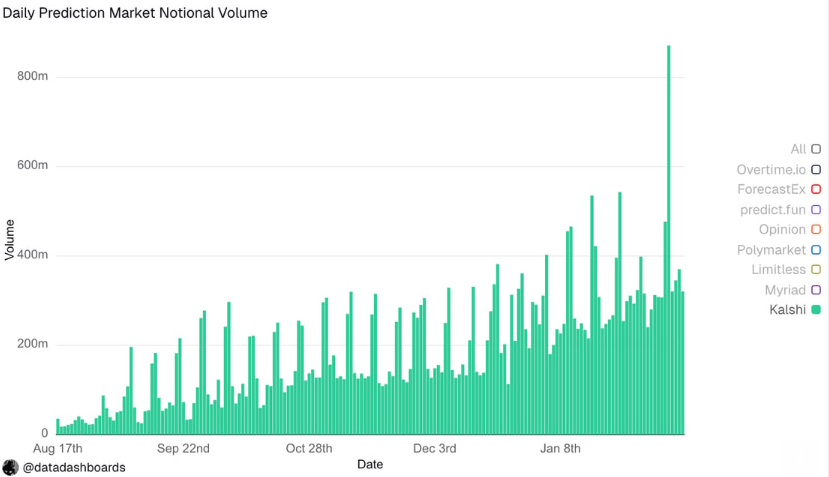
Kalshi reached record liquidity during the Super Bowl, processing over $800 million in game-day volume with enough market depth to absorb a reported $22 million position without materially moving odds, signaling a step change in execution quality. At the same time, ICE integrated Polymarket data into a compliant sentiment and signals feed for traditional market participants, mapping event probabilities to securities for risk and portfolio analysis. Together, deeper liquidity and institutional-grade data integration suggest prediction markets are evolving from niche speculation venues into scalable infrastructure capable of supporting serious capital and influencing broader financial decision-making.
Source: Dune
Vitalik Warns of “Corposlop” in Prediction Markets
Vitalik Buterin cautioned that prediction markets risk drifting toward high-volume, low-signal betting formats, arguing that short-term crypto price and sports wagers may drive revenue but offer little long-term informational value. While platforms like Polymarket have reached billions in volume, studies show profits are concentrated among a small cohort of systematic traders, with most users losing money, reinforcing incentives for impulse-driven design. Buterin called for a broader reimagining of the category, suggesting prediction markets should focus on hedging real-world risks and even serve as the foundation for personalized financial stability tools rather than simply optimizing for engagement and fees.
Long-Term Holders Start to Crack
Bitcoin’s February dip has put unusual pressure on long-term holders, with key metrics like the Long-Term Holder SOPR slipping below 1 for the first time since May 2022, signaling veteran investors are realizing losses. Accumulation during this drawdown has been weaker than during crises like LUNA or FTX, raising concerns that deeper correction risk remains, with $54,000 flagged as a potential support level. Still, some traders argue the move reflects orderly deleveraging rather than systemic stress, pointing to strong buyer defense near $60,000 and upcoming catalysts like regulatory clarity, rate cuts, and ETF inflows as potential drivers of recovery.
Regulation
BlackRock Picks Uniswap
BlackRock has made a strategic investment in Uniswap, accumulated UNI, and is bringing its $2.2B tokenized Treasury fund BUIDL directly onto the DEX, allowing eligible investors to trade shares 24/7 against stablecoins. While the immediate UNI price pop grabbed attention, the bigger signal is infrastructural: the world’s largest asset manager chose public DeFi rails over private blockchain alternatives. By moving tokenized Treasuries onchain, BlackRock gains faster settlement, continuous liquidity, and programmable collateral utility, unlocking capital efficiency that traditional markets cannot match. The message is clear: DeFi is no longer an experiment at the margins, but emerging as institutional market plumbing.

Source: Dune
Crypto VC Isn’t Dead, It’s Concentrated
Dragonfly’s $650 million fund close challenges the narrative of a crypto VC extinction event, even as the shape of capital deployment has clearly shifted. While 2025 saw more than $20–36 billion in funding depending on the dataset, the majority flowed into later-stage companies with real revenue and financial use cases rather than speculative consumer hype. Stablecoins, trading infrastructure, DeFi, and prediction markets absorbed much of the capital, reflecting crypto’s strongest product-market fit in finance. The era of broad web3 experimentation may have cooled, but venture dollars are consolidating around scalable financial infrastructure that institutions increasingly view as durable.
Robinhood’s Crypto Slump Hides a Margin Story
Robinhood’s Q4 2025 earnings showed transaction revenue up 15% year-over-year, but crypto revenue fell 38%, driving a broader miss versus expectations. Notably, crypto trading volume dropped 52%, meaning the platform’s effective take rate actually increased, likely due to a shift toward higher-margin altcoins and newer listings even as overall activity contracted. Meanwhile, “Other” revenue surged from $84 million to over $300 million, fueled by Gold subscriptions and early traction in event contracts, yet shares still fell about 8% after hours and remain roughly 50% below their October peak, reflecting investor skepticism despite improving diversification.

Source: Robinhood
Prosecutors Recover Seized Bitcoin After Phishing Blunder
South Korean prosecutors have recovered 320.8 BTC, worth roughly $21 million, after a hacker returned funds stolen when investigators mistakenly entered recovery seed phrases into a phishing site during a probe last year. The theft went unnoticed for months, but authorities limited the hacker’s ability to cash out by blocking transfers to centralized exchanges. The returned bitcoin has since been moved to a local exchange for safekeeping, and the incident has triggered a broader review of how law enforcement agencies manage seized digital assets.
Other Domestic Regulation Updates
- The Most Surprising Bitcoin and Crypto Stories in the Epstein Files
- Strategy Buys More Bitcoin as $50 Billion BTC Stash Remains Underwater
- Robinhood launched the public testnet for Robinhood Chain, an Ethereum Layer 2 network built using Arbitrum technology
- Polymarket Files for Crypto Token Trademarks as Legal Battles Mount
- California Begins Enforcing State-Level Crypto Licensing With DFAL
- Anthony Scaramucci's son buys Logan Paul's previously tokenized Pokémon card for record $16 million
Other International Regulation Updates
- Binance is experiencing significant capital flight with reports indicating between $10-17 billion in withdrawals over a 7-day period, raising concerns about the exchange's stability and prompting comparisons to the FTX collapse among crypto community members
- Danske Bank Offers Bitcoin, Ethereum ETPs to Investors, Ending Eight-Year Crypto ‘Ban’
- The European Commission is reportedly pushing for an EU-wide ban on all cryptocurrency transactions involving Russia-based entities to counter sanctions evasion
- Hong Kong policymakers announced initiatives at Consensus Hong Kong aimed at strengthening the local digital asset ecosystem
Pain & Gain
Pain
- Bitcoin Miner Cango Dumps $305 Million in BTC to Fuel AI Pivot
- Publicly Traded Blockchain Lender Figure Confirms Customer Data Breach
- Metaplanet Posts $605 Million Loss After Spending Billions on Bitcoin
- Gemini parts ways with CFO, COO and CLO
- Peter Thiel and Founders Fund exit Ethereum treasury firm ETHZilla, SEC filing shows
Gain
Important Legal Notices
This reflects the views MJL Capital LLC (“MJL”), but it should in no way be construed to represent financial or investment advice. Nothing in this correspondence is intended to constitute or form part of, and should not be construed as, an issue for sale or subscription of, or solicitation of any offer or invitation to subscribe for, underwrite, or otherwise acquire or dispose of any security, including any interest in any private investment fund managed by MJL. Any such offer may only be made pursuant to a formal confidential private placement memorandum of any such fund, which may be furnished to potential investors upon request and which will contain important information to be considered in connection with any such investment, including risk factors associated with making any investment in any such fund. Further, nothing in this correspondence is, or is intended to be treated as, investment or tax advice. Each recipient should consult their own legal, tax and other professional advisors in connection with investment decisions.

Domenic Salvo is a Managing Partner at MJL Capital, helping lead Portfolio Research and Investor Relations.