Top Stories
Stablecoins Beyond Supply
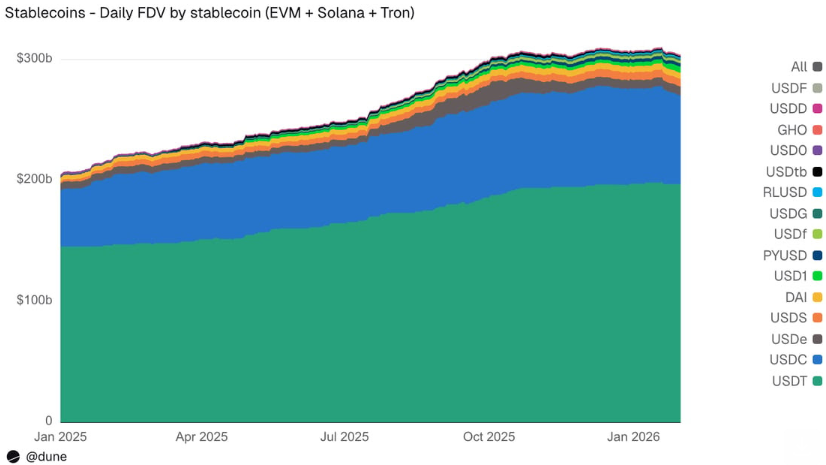
Stablecoins have surpassed $300B in supply, but the more important story is how that capital is distributed, concentrated, and actually used. While USDT and USDC still dominate with nearly 90% share, newer entrants are growing rapidly but remain highly concentrated, often with the majority of supply held by a handful of wallets. Activity is increasingly driven by infrastructure rather than simple payments, with $10T in monthly transfer volume led by DEX liquidity, arbitrage, and protocol flows, and stark differences emerging across chains in how the same assets behave. As institutions enter through regulated rails and global issuers expand into local currencies, stablecoins are evolving from dollar-denominated liquidity into programmable settlement layers, where ownership structure, velocity, and integration matter as much as headline supply.
Source: Dune
Vitalik Asks the Hard Question
Vitalik Buterin is challenging Ethereum to look beyond financial primitives and ask whether it has meaningfully improved everyday life, pointing to technologies like Signal, Starlink, and open-source AI as examples of tools delivering tangible real-world impact. His framing introduces the idea of “sanctuary technologies,” systems that provide users with resilience, autonomy, and protection in an increasingly uncertain world. The implication is not that Ethereum should abandon finance, but that its next phase must expand into applications that address deeper human needs, shifting from abstract infrastructure toward tools that deliver clear, lived utility.
ICE Bridges Wall Street and Crypto
Intercontinental Exchange’s ~$200 million investment in OKX marks a major step in the convergence of traditional finance and crypto, pairing one of the world’s most regulated market operators with a leading global exchange. The partnership creates a two-way pipeline, with ICE leveraging OKX price data for new derivatives products while OKX moves toward offering tokenized NYSE-listed equities to its users. More than capital, the deal signals strategic alignment around market structure, positioning OKX for deeper U.S. access and highlighting tokenized equities as a key battleground where crypto platforms could begin competing directly with traditional brokerages.
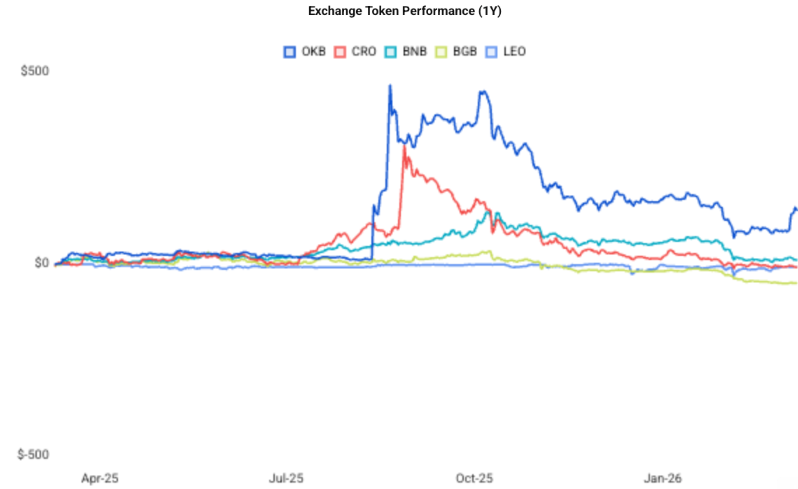
Source: The Block
Agents Get Wallets
The agent economy is moving from concept to infrastructure as Coinbase’s Agentic Wallets and Base enable software agents to custody USDC, interact with DeFi, and transact autonomously at near-zero cost. Early traction is already visible, with tens of thousands of agents registered and meaningful transaction and trading activity emerging across the ecosystem. The shift is bigger than AI UX, as it gives software direct access to programmable money, potentially reshaping payments, capital allocation, and even financial intermediation. As agents begin to route value at scale, the next battleground will center on identity, liability, and compliance frameworks for non-human actors, determining who captures and governs this new class of economic participants.
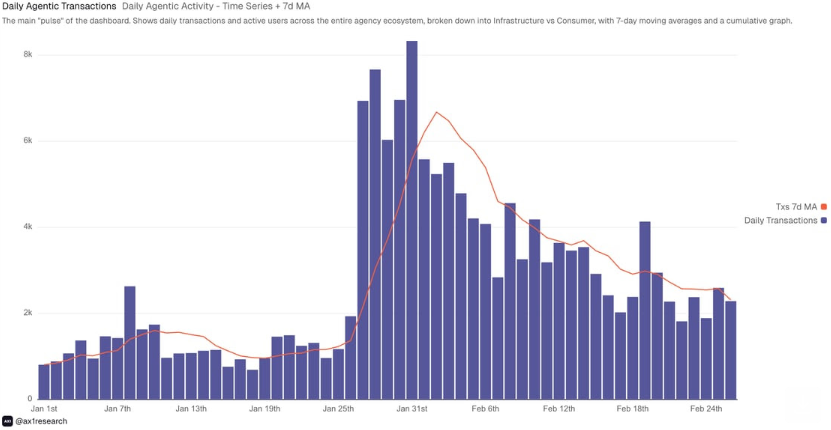
Source: Dune
20 Million Down, 1 Million to Go
Bitcoin has surpassed 20 million mined coins, marking a major milestone in its fixed supply schedule that will see the final 1 million BTC issued gradually over the next century. With issuance already reduced through successive halvings, the network’s monetary policy continues to shift toward increasing scarcity and predictability, reinforcing Bitcoin’s design as a long-duration, supply-constrained asset. As block rewards decline over time, the milestone also highlights the growing importance of transaction fees and long-term network sustainability.
Regulation
Flows Return, Policy Takes Center Stage
Bitcoin’s recent rebound is being driven by a shift in underlying market structure rather than price momentum, with spot ETF inflows reversing months of outflows and signaling renewed institutional demand. At the same time, policy developments such as progress on the CLARITY Act and deeper integration of crypto into financial infrastructure, including Kraken’s access to Federal Reserve payment rails, are reinforcing a more durable foundation for the industry. Together, these factors suggest the market is transitioning from macro-driven uncertainty toward a phase increasingly shaped by regulation, infrastructure, and capital flows.
From Crypto to Core Banking
Moves by Kraken, Revolut, and zerohash highlight a structural shift as crypto firms push directly into the heart of the U.S. financial system rather than operating at its edges. By securing Fed access, pursuing bank charters, and building regulated infrastructure, these companies are removing reliance on fragile banking partners and embedding crypto into core financial rails. The broader implication is a rapid convergence between crypto and TradFi, where the boundary between the two is dissolving and decentralized systems are increasingly positioned not as alternatives, but as the underlying infrastructure for global finance.
DOJ Pushes Ahead on Crypto Privacy Case
The U.S. Department of Justice is seeking to retry Tornado Cash developer Roman Storm on serious conspiracy charges after a jury previously deadlocked, signaling an aggressive stance on holding developers accountable for how their code is used. The move comes amid conflicting signals from Washington, as the Treasury has acknowledged legitimate uses for privacy tools even while prosecutors pursue precedent-setting enforcement. The case underscores a growing tension in U.S. crypto policy, where the legal boundaries for non-custodial developers and financial privacy remain unsettled and increasingly consequential for the future of open-source innovation.
Regulators Finally Get on the Same Page
The SEC and CFTC have signed a coordination pact to align crypto rulemaking, supervision, and enforcement, marking a major step toward resolving years of fragmented oversight in U.S. digital asset regulation. The agreement introduces a joint initiative to harmonize product definitions, clearing rules, and reporting requirements, aiming to reduce duplicative processes and regulatory ambiguity for firms operating across spot, derivatives, and tokenized markets. By moving toward a more unified framework, the pact could lower compliance friction, keep innovation onshore, and give institutions the clarity needed to build and scale in the U.S. without navigating conflicting regulatory regimes.
Other Domestic Regulation Updates
- Mark Zuckerberg’s Meta is planning stablecoin comeback in the second half of this year
- Chainlink’s Taylor Lindman joins SEC as chief counsel for crypto task force
- Kraken Secures Access to Fed’s Core Payment Systems
- Morgan Stanley Picks Coinbase, BNY as Custodians for Planned Bitcoin ETF
- NYSE Just Bought Into A Major Crypto Exchange
- IRS proposes letting crypto exchanges like Coinbase require electronic delivery of tax forms
- CFTC Moves to Define the Rules for Prediction Markets
- White House crypto advisor counters Jamie Dimon's stablecoin yield logic
Other International Regulation Updates
- The Netherlands Gambling Authority (Ksa) ordered Polymarket to immediately cease offering services, deeming its prediction markets "illegal gambling" under Dutch law
- Hong Kong-based stablecoin payments firm RedotPay explores $1 billion US IPO at $4 billion valuation
- Metaplanet Deepens Bitcoin Strategy With $25M Investment Plan, New Venture Arm
- Fresh accounts netted $1 million on Polymarket hours before US airstrikes on Iran
- Binance sues WSJ over Iran-linked report as DOJ probes alleged sanctions evasion
Pain & Gain
Pain
- MrBeast Employee Fined, Suspended by Kalshi for Insider Trading on YouTube Videos
- Iranian Exchange Outflows Spiked
- Kalshi Sued Over Refusing to Pay Out Prediction Market After Iran Leader's Death
- Brera Stock Plunges Amid Growing Solana Pivot as 'Solmate' Firm Dumps Soccer Teams
- Dubai’s Token2049, TON Crypto Conferences Canceled as Iran Conflict Rages On
- Marc Zeller's ACI to leave Aave DAO in July amid growing governance tensions
- Crypto whale loses nearly $50 million swapping USDT for AAVE
Gain
- Coinbase CEO Says Quantum Computing 'Solvable Issue' for Crypto
- 'Ethereum Is Going Hard': Vitalik Buterin Backs Censorship Resistance Upgrade
- Top Bitcoin Mining Pool Operator Foundry Is Getting Into Zcash
- Ripple launches $750 million share buyback at $50 billion valuation
- Tether Backs Ark Labs’ $5.2 Million Bet on Bitcoin’s Stablecoin Revival
- BlackRock's staked Ethereum ETF records over $15.5 million volume on first day
Important Legal Notices
This reflects the views MJL Capital LLC (“MJL”), but it should in no way be construed to represent financial or investment advice. Nothing in this correspondence is intended to constitute or form part of, and should not be construed as, an issue for sale or subscription of, or solicitation of any offer or invitation to subscribe for, underwrite, or otherwise acquire or dispose of any security, including any interest in any private investment fund managed by MJL. Any such offer may only be made pursuant to a formal confidential private placement memorandum of any such fund, which may be furnished to potential investors upon request and which will contain important information to be considered in connection with any such investment, including risk factors associated with making any investment in any such fund. Further, nothing in this correspondence is, or is intended to be treated as, investment or tax advice. Each recipient should consult their own legal, tax and other professional advisors in connection with investment decisions.

Domenic Salvo is a Managing Partner at MJL Capital, helping lead Portfolio Research and Investor Relations.